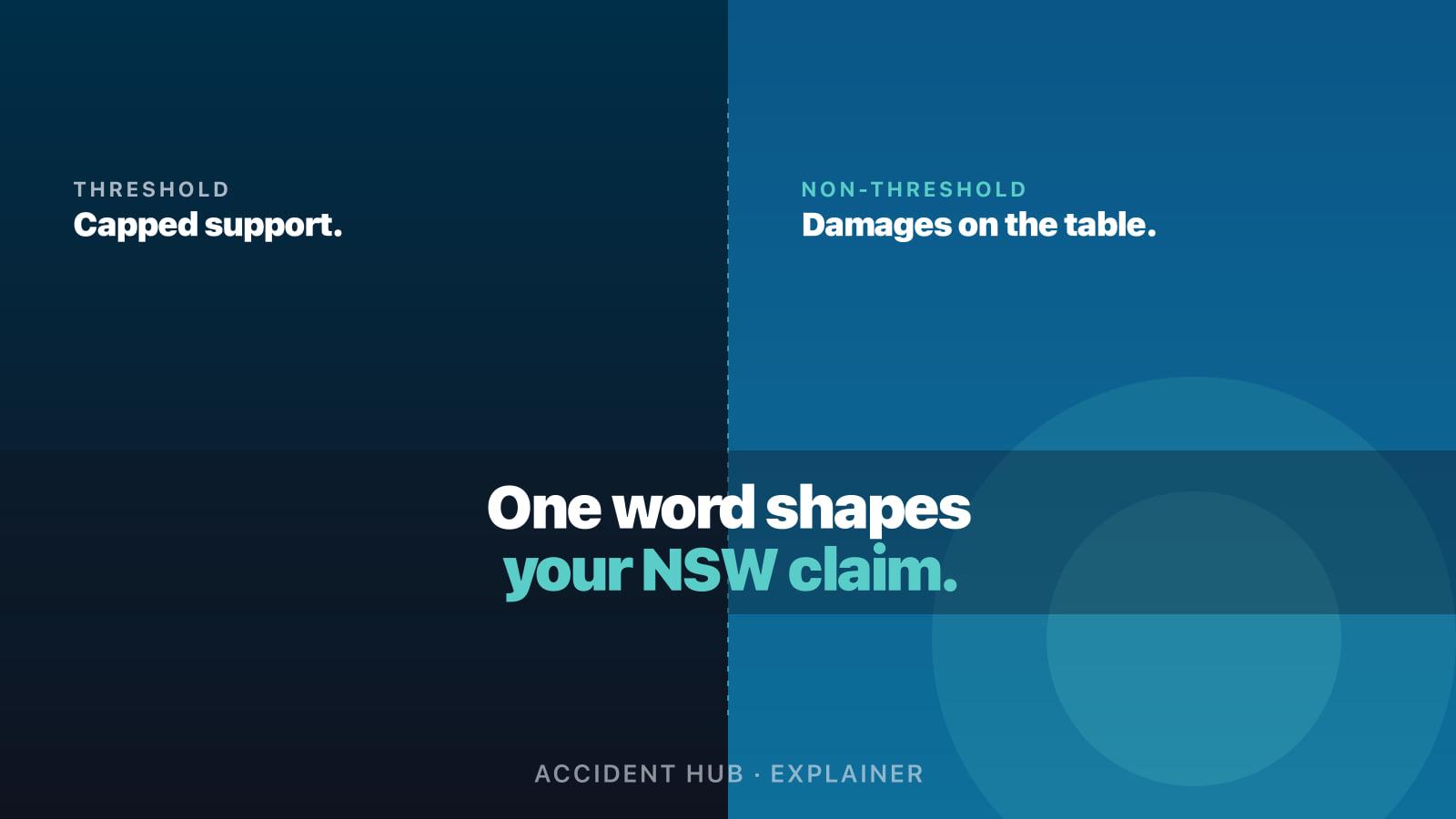
If you've been looking into a NSW motor accident claim, you'll have seen the word threshold used a lot. It's the most important word in the scheme and the least explained. Getting it right decides whether your claim ends with statutory support or carries on into a damages settlement that can be ten times that amount.
Here's what threshold actually is, how the test works in NSW, and why the classification is worth fighting over.
The split inside every NSW CTP claim
Every injury claim under the NSW CTP scheme goes through two stages:
- Stage one — statutory benefits. Weekly income support and paid treatment, running for a good while. Available regardless of fault. No threshold test required — if you're injured in a NSW motor accident, statutory benefits are on the table.
- Stage two — damages. A lump-sum for pain and suffering, future economic loss, and future care. Available only if (a) you're not mostly at fault, and (b) your injury passes the non-threshold classification.
The threshold test is stage two's gatekeeper. It decides who gets to pursue damages and who's capped at the shorter statutory support.
What threshold injury means
Under NSW law, a threshold injury is defined narrowly. In plain English, it means:
- A soft-tissue injury — strain, sprain, contusion, or minor disc bulge — that doesn't result in complete rupture of a ligament or tendon, complete severance of a nerve, or a fracture.
- A minor psychological or psychiatric injury — temporary anxiety, adjustment disorder — that doesn't meet diagnostic criteria for a recognised psychiatric illness.
Everything else is a non-threshold injury — sometimes called a "serious" injury under older schemes, though the current NSW law doesn't use that word.
What counts as non-threshold
Non-threshold injuries include, but aren't limited to:
- Fractures of any bone — including seemingly minor ones like a fractured finger or a crack in a rib.
- Complete rupture of a tendon or ligament (ACL, rotator cuff, Achilles, for example).
- Complete severance or permanent damage to a nerve.
- Burns that meet severity criteria.
- Injuries requiring surgery — joint replacement, spinal fusion, internal repair.
- Psychological injuries diagnosed as PTSD, major depressive disorder, or other recognised psychiatric illnesses, with proper DSM-5 criteria met.
- Brain injury, even mild traumatic brain injury with ongoing cognitive symptoms.
Threshold examples (capped at statutory benefits)
Typical threshold injuries:
- Whiplash that resolves within months without imaging or surgery.
- Lower-back strain with no disc herniation or nerve compression.
- Shoulder strain without a rotator cuff tear.
- Adjustment disorder — anxious-sleeping, irritable — that doesn't tip into a diagnosable PTSD or depression.
Non-threshold examples (damages on the table)
- Fractured wrist from bracing against the steering wheel.
- Herniated disc with nerve impingement (radiculopathy) confirmed on MRI.
- Complete tear of the rotator cuff requiring surgery.
- Concussion with persistent cognitive symptoms six months post-accident.
- PTSD diagnosed by a treating psychiatrist with DSM-5 criteria documented.
Who decides threshold — and when
The CTP insurer makes the first call on threshold classification. It usually happens a few months into the claim, once early medical evidence is in. The insurer issues a written decision: threshold, or non-threshold.
If you disagree with the insurer's decision, you can request an internal review. If the internal review doesn't change it, the next stop is the Personal Injury Commission (PIC) — an independent tribunal with a motor accidents division. A PIC medical assessor, who is a specialist clinician, reviews your file and makes an independent determination.
Why the classification is worth fighting for
Threshold classification caps how long the support runs for. That's real money — weekly income support, paid medical treatment, paid care — but it ends sooner than you'd want. Non-threshold keeps the same support running and opens the door to a damages settlement at the end.
A damages settlement for a non-threshold injury can include:
- Past economic loss — income lost from the accident to the settlement date.
- Future economic loss — income projected to be lost beyond settlement, especially where you can't return to your previous job.
- Pain and suffering — where the impairment passes a separate threshold.
- Future medical and care costs — ongoing treatment, aids, equipment, home modifications.
The size of a damages settlement varies wildly by injury severity, age, income, and capacity. What's consistent is that non-threshold classification is the entry ticket. Without it, the damages door doesn't open.
The evidence that moves the needle
Threshold decisions turn on medical evidence, not on how bad you feel or how long you've been off work. The PIC reviewer wants to see:
- Imaging results — MRI, CT, X-ray — with radiologist reports.
- Specialist reports — orthopaedic surgeon, neurologist, psychiatrist.
- GP notes — ideally contemporaneous, from the week of the accident forward.
- Physiotherapy notes — objective findings, range-of-motion measurements, not just "patient reports ongoing pain".
- For psychological injuries, a psychiatrist's report with DSM-5 criteria explicitly addressed.
Contemporaneous records are the difference between a clean non-threshold finding and a losing argument. The GP note from the week of the accident — the one that says "rear-ended at 60km/h, cervical spine pain, limited rotation" — is worth more than any amount of advocacy two years later.
A special note on psychological injuries
Psychological injury is the trickiest part of the threshold test. Many people feel anxious after a crash — disrupted sleep, on-edge driving, reluctance to get back behind the wheel. That's normal and often resolves on its own; under NSW law it generally sits as a threshold injury.
What pushes a psychological injury into non-threshold territory is a formal diagnosis by a psychiatrist, made against DSM-5 criteria, of a recognised condition — typically PTSD, major depressive disorder, or anxiety disorder meeting severity markers. The diagnosis must connect the condition to the accident and must be evidenced by ongoing treatment.
If you're struggling mentally after a crash, see a GP early and ask for a mental health care plan. The earlier the documentation starts, the stronger any later claim.
How Accident Hub handles threshold
Threshold classification is where the scheme gets technical. We line up the medical evidence while you're still in treatment, make sure the right specialist reports are in the file, and where the insurer classifies as threshold but the evidence says otherwise, we take it to internal review and, if needed, to the Personal Injury Commission.
The short version: we don't accept an insurer's first threshold call if the clinical picture doesn't match it. That's the piece that turns a capped statutory claim into a full damages claim — and it's the piece most people going it alone never realise is negotiable.
Had a car accident? Call Accident Hub.
Ring us. We'll talk through your situation, explain what your injuries mean in plain English, and help sort what needs sorting. One call is enough to start.