Every NSW driver has paid for CTP. Very few actually know what it does. The green slip you buy at registration time is one of the most misunderstood products in Australian insurance — and that's a problem, because it's the thing that pays for you and your passengers if the crash leaves anyone injured.
This article explains how CTP actually works in NSW. No jargon. No marketing. Just what covers what, who can claim, and where the 28-day deadline sits.
What CTP actually is
CTP stands for Compulsory Third Party. In NSW, every registered vehicle must carry a CTP policy — you can't renew rego without one. The policy sits with one of a handful of licensed NSW CTP insurers (Allianz, QBE, NRMA, AAMI, GIO, Youi), and you picked one when you paid for the green slip.
CTP does not cover the car. Let that land for a second — most people think it does, and most people are wrong. CTP covers injury to people, not damage to vehicles. Damage to cars is covered by comprehensive insurance (if you bought it) or by the at-fault driver's property damage cover — a separate policy entirely.
Who is covered under CTP
NSW CTP covers injury to:
- The driver of any vehicle involved.
- Passengers in any vehicle involved.
- Motorcyclists and their pillion passengers.
- Cyclists injured by a motor vehicle.
- Pedestrians struck by a motor vehicle.
- Rideshare drivers and rideshare passengers (Uber, DiDi, Ola — the rideshare driver's CTP is the vehicle's green slip, same as any car).
The entitlement follows the vehicle, not the person. If you're injured in your mate's car, it's your mate's CTP policy that covers you — not your own. If you're hit by another car while crossing the street, it's the other car's CTP policy that covers you — even though you don't own a car.
The two halves of a NSW CTP claim
A CTP injury claim splits into two very different halves.
Half one: statutory benefits
Statutory benefits are the defined, no-fault-required part of the scheme. If you're injured in a NSW motor accident, you're entitled to statutory benefits regardless of who caused the crash — including if you caused it. This is the part most people don't know about.
Statutory benefits cover three things:
- Weekly income support — paid to replace most of the money you'd otherwise be earning while you're off work. Runs for a good while, though it's capped rather than open-ended.
- Treatment and care — GP visits, physio, psychology, imaging, specialists, medications — paid direct to the provider, not reimbursed from your pocket.
- Help at home — if your injury stops you doing basic things around the house, paid help can be approved.
Half two: damages (common-law claim)
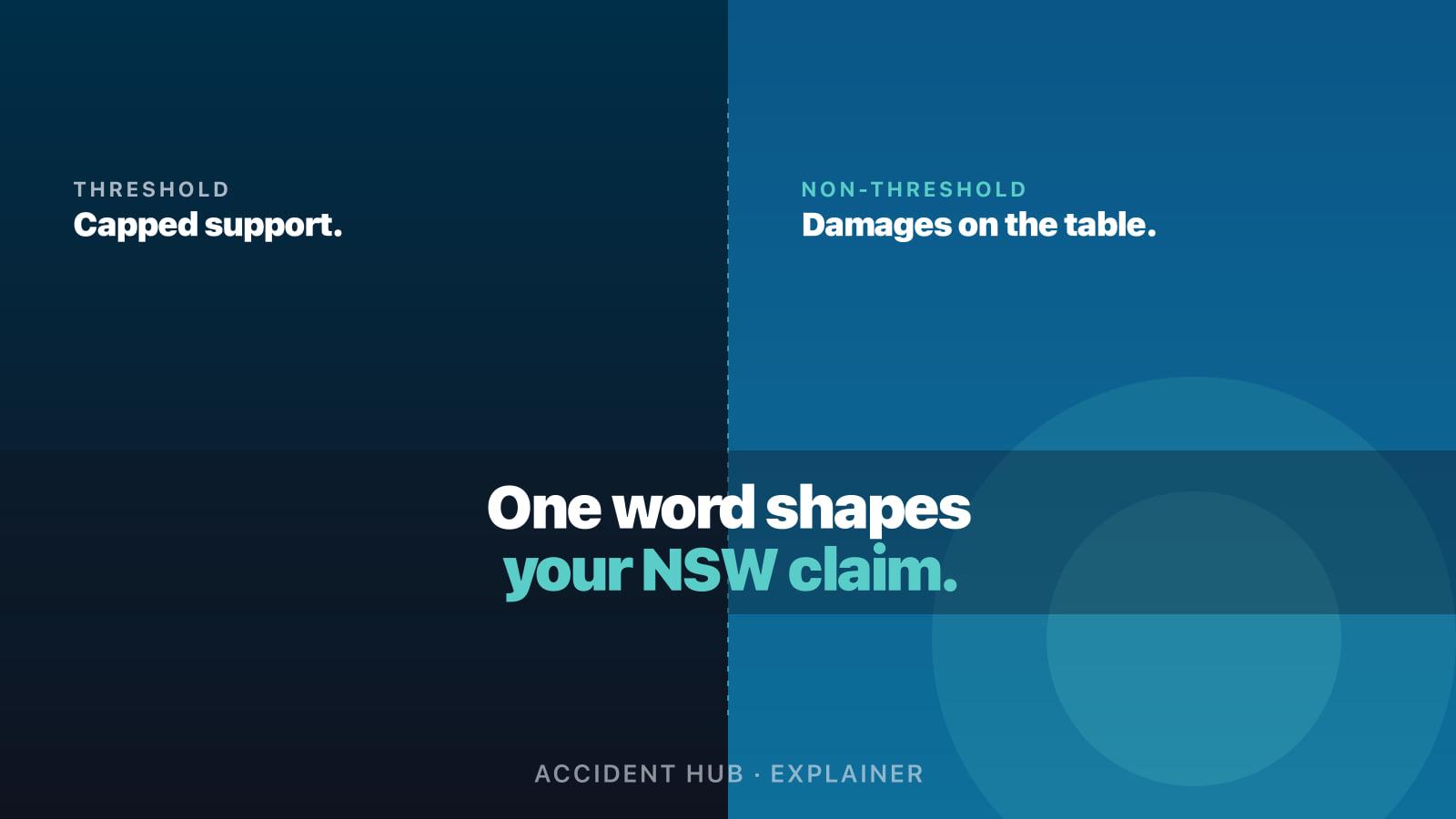
Damages is the traditional lump-sum side of the claim. You can pursue damages if you're not mostly at fault, and, for most claims, your injury is classed as non-threshold — meaning something more serious than minor soft-tissue or minor psychological injury. (More on threshold in our threshold injury article.)
Damages can cover pain and suffering, future economic loss (wages you'd otherwise have earned), and future care. It's typically settled once your injury has stabilised, often 18–36 months post-accident. Damages settlements are one-off payments, not ongoing — statutory benefits run for a good while, then stop; damages sit separately as a lump sum where you're eligible.
Timing — the deadline you can't miss
A CTP claim should be lodged within 28 days of the accident to preserve the full backdated entitlement to weekly payments. Lodge inside 28 days and weekly income support is payable from the date of the accident. Lodge late, and the insurer can reasonably argue that the weeks between the accident and lodgement aren't payable.
How a CTP claim is lodged
The formal mechanism is a CTP Personal Injury Claim Form, lodged with the insurer of the at-fault vehicle (or, if you can't identify the at-fault driver, with the Nominal Defendant Scheme). The form asks about the accident, the injury, pre-accident earnings, and treatment so far.
The insurer then has statutory timeframes to accept or deny the claim. If accepted, weekly payments and treatment approvals start flowing. If denied, the claim can be reviewed internally and then externally through the Personal Injury Commission.
Fault and CTP — what actually matters
Fault is the part of CTP that trips people up most. Here's the plain version:
- Statutory benefits are largely not-fault. You get them whether you caused the crash or someone else did. There are some exclusions (drink driving, driving unlicensed in some scenarios) but for the great majority of crashes, fault doesn't gate statutory benefits.
- Damages are fault-sensitive. You can pursue damages where you're not mostly at fault. If you were mostly at fault, damages are blocked — but the weekly support and treatment side still runs.
- The other driver's fault is worked out from the evidence. Police report, dashcam, photos, witness statements. It's a negotiation with the insurer, sometimes reviewed through the Personal Injury Commission.
Threshold vs non-threshold — the other lever
Beyond fault, NSW uses a threshold test for damages. Minor injuries — minor whiplash, minor soft-tissue, minor psychological injury — are classed as threshold injuries. Threshold injuries get full statutory benefits for a good while, but are generally excluded from a damages lump sum. Non-threshold injuries — anything more serious, including most fractures, surgeries, and permanent impairments — can pursue damages where fault is on the other side.
The threshold decision is made by the insurer early in the claim and can be reviewed through the Personal Injury Commission if you disagree. Getting the threshold classification right matters — it's the single biggest determinant of whether damages sit on the table.
What CTP doesn't cover
To keep expectations clean, here's the list of things CTP does not pay for:
- Damage to your car (that's comprehensive or third-party property).
- Damage to other people's cars (that's third-party property).
- Property damage to fences, poles, buildings.
CTP is a personal-injury scheme. If you're injured in a NSW motor accident, that's the claim we help you with.
How Accident Hub handles CTP
We lodge your CTP claim inside the 28-day window, we chase the insurer for approvals, we argue threshold misclassifications, and where damages are on the table we see them through to settlement. What we don't do is ask you to learn the scheme while you're in pain. That's our job.
The only thing you need to know is which of the four customer types you are after a NSW crash — not injured / injured, at fault / not at fault. We've built Accident Hub to handle all four. Unlike most compensation law firms, that includes drivers who caused the crash themselves — because there's still meaningful support on the table, and someone needs to lodge them for you.
Had a car accident? Call Accident Hub.
Ring us and we'll explain the bits that apply to you, in plain English. One call is enough to get started — no matter who caused the crash.